The Day the Stock Market Had a Birthday, and Nobody Wrote Down the Time
On May 17, 1792, twenty-four men signed a two-sentence agreement on Wall Street. Two centuries later, astrologers are still arguing about what time they did it, because whoever wins the argument gets to say what sign the stock market is rising in.
Two sentences and a tree
The spring of 1792 was a bad one to be a New York stockbroker. In March, William Duer, a speculator with friends in very high places, stopped paying his creditors, and the city went through what history now calls the Panic of 1792. Into that mess, two months later, walked twenty-four brokers with a short piece of paper.
The whole of it fits on a napkin. "We the Subscribers, Brokers for the Purchase and Sale of the Public Stock, do hereby solemnly promise and pledge ourselves to each other, that we will not buy or sell from this day for any person whatsoever, any kind of Public Stock, at a less rate than one quarter percent Commission on the Specie value and that we will give preference to each other in our Negotiations."
That is it. A minimum commission and a promise to trade with each other first. It is the founding document of the New York Stock Exchange, and in spirit it is a group chat agreeing not to undercut each other on price.
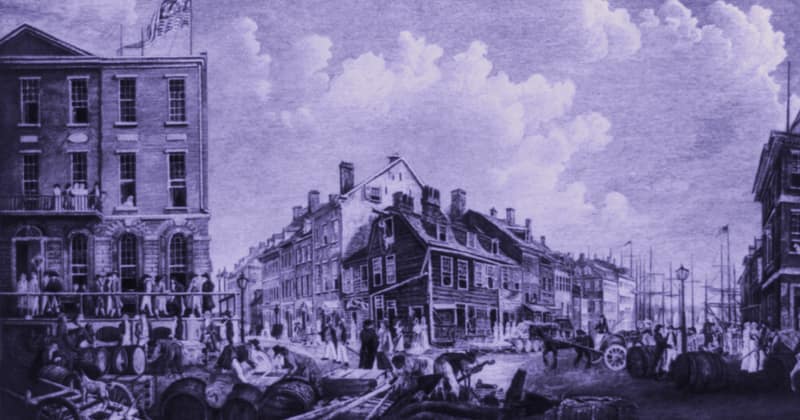
It is called the Buttonwood Agreement after a buttonwood tree, a sycamore, outside 68 Wall Street, where the brokers were in the habit of meeting. The picture most people carry around, of two dozen men in tricorn hats signing under the branches, is the legend. Historians are careful to say the agreement was named for their meeting place, not that it was signed there. The original document sits in the exchange's own archives. The tree is long gone.
Why a contract gets a horoscope
To an astrologer, a birth is not only a baby. Mundane astrology, the old branch that reads nations and cities, casts charts for coronations, declarations and treaties, on the idea that anything with a moment of beginning has a sky above that moment. Financial astrologers took that idea and pointed it at companies.
The person who made it a working method was Bill Meridian, whose catalogue runs to more than a thousand charts. He explains the move himself: "Not satisfied with the relationship of the chart of incorporation with share price movements, I turned to the horoscope of first trade." The first-trade chart, cast for the moment a share could actually be bought, became the convention, and it is the one we use on every company page. When we say Nvidia is an Aquarius, that is what we mean.
So what is the first-trade chart of the market itself?
Everybody agrees on the day
Here the financial astrologers, a group not known for agreeing, mostly do. The day is May 17, 1792. On that day the Sun sat in the late degrees of Taurus, the sign of the bull, which is the kind of coincidence that makes a believer's heart sing and a skeptic's eye roll. The ruler of Taurus is Venus, planet of money and pleasant things. The Moon spent the day in Aries, the ram, which charges first and reads the prospectus later. If you were writing a novel about American markets, you would not dare make them a Taurus with an Aries Moon. Too on the nose.
You could pick other days. A constitution was adopted on March 8, 1817, creating the New York Stock & Exchange Board. The name "New York Stock Exchange" arrived in 1863. A rival board merged in during 1869, and at least one chart dated May 11 of that year circulates. The Dow Jones Industrial Average first appeared on May 26, 1896, at 40.94. But the Buttonwood signing is the one the field keeps coming back to, because it is the moment the club was formed.
Nobody agrees on the time
The problem is the clock. A Sun sign only needs the day. The rising sign, the Ascendant, changes roughly every two hours, and the houses that astrologers read for money and reputation hang off it. Nobody wrote down when the twenty-four brokers signed. So astrologers did what astrologers do with a missing birth time: they rectified it, working backward from events to the moment that best explains them.
The best known answer comes from Louise McWhirter, whose 1938 book on market forecasting gave the exchange a time of 7:52 in the morning, with 14 degrees of Cancer rising. The astrologer and historian Graham Bates credits her with that rectification, and it is still the chart you will find quoted most often. A Cancer rising market, ruled by the Moon, is a market that runs on mood. Make of that what you will.
Then the variants. An Astrologers Fund reader answer lists one chart at 10:10 in the morning with Leo rising and another at 8:52 with late Cancer. Others cited online prefer 10:00 or 10:30. Kenneth Bowser, writing in American Astrology in 2000, uses noon, on the grounds that the original members regularly met at noon, and saw "no reason to meddle with a horoscope calculated for that time." Every one of those charts has its defenders, and every defender can show you events that fit.
The twist: the honest answer from inside the room
The most quotable line in the whole debate comes from a financial astrology outfit itself. After laying out three candidate charts for the exchange, the Astrologers Fund reader answer says: "Now, I am telling you none of the above works worth a darn," and points the reader to a different chart entirely.
That is the story of the NYSE horoscope in one sentence. A birthday everyone agrees on, a birth time nobody recorded, at least five competing clocks, and practitioners who will tell you, sometimes in writing, that the famous chart does not do what it is famous for. When a chart can be adjusted until it fits what already happened, fitting what already happened stops being evidence.
We did not rectify anything. We tested whether charts carry a return signal at all, with placebos, and published the result: they do not. What a first-trade chart does carry is a story, and the story of a market founded by twenty-four nervous men in a bad spring, promising to be nice to each other on price, is a very good one. It is a Taurus. It is stubborn. It likes nice things. You could have guessed that without the ephemeris.
If birthdays for companies amuse you, follow a few charts and see how often the sky and the story rhyme, and how often they faceplant. Both are fun. Neither is a forecast.
Sources: NYSE: History; Wikipedia: Buttonwood Agreement; Wikipedia: Panic of 1792; Wikipedia: New York Stock Exchange; Wikipedia: Dow Jones Industrial Average; Bill Meridian on first-trade charts; Graham Bates, Urania Trust; Astrologers Fund; Kenneth Bowser on the Buttonwood chart; Wikipedia: Louise McWhirter. Planet positions are computed by our own ephemeris.