The Most Powerful Woman Nobody Had Heard Of Kept the President's Calendar in Green and Red Ink
For seven years, by her own account, a San Francisco socialite with a Vassar degree in art history picked the minute Air Force One took off. The White House chief of staff found out, kept a colour-coded calendar to cope, and then put it all in a book.
The secret in chapter one
In May 1988, Donald Regan, a former Wall Street chairman who had been fired as Ronald Reagan's chief of staff the year before, published a memoir called For the Record. Most memoirs by fired chiefs of staff settle scores about budgets. This one opened a door nobody in Washington had known was there.
"Virtually every major move and decision the Reagans made during my time as White House Chief of Staff was cleared in advance with a woman in San Francisco who drew up horoscopes to make certain that the planets were in a favorable alignment for the enterprise," he wrote. He called it "what was probably the most closely guarded domestic secret of the Reagan White House."
Then came the detail that made the story immortal. "I kept a color-coded calendar on my desk (numerals highlighted in green ink for 'good' days, red for 'bad' days, yellow for 'iffy' days) as an aid to remembering when it was propitious to move the President of the United States from one place to another, or schedule him to speak in public, or commence negotiations with a foreign power."
Picture it. The most powerful office on earth, run on a desk calendar that looks like a teenager's planner.
The Friend
Regan never knew her name. Inside the West Wing she was just "the Friend." TIME magazine found her within days: "Nob Hill Socialite Joan Quigley, sixtyish, a Vassar graduate."
Her life story reads like a society column, because for a while it was one. Born in Kansas City in 1927, raised, the New York Times later reported, in the penthouse of a hotel on San Francisco's Nob Hill, driven around in a Rolls-Royce, a degree in art history from Vassar, a preference for being called Miss Quigley. She wrote an astrology column for Seventeen and was a regular guest on Merv Griffin's talk show from 1972 to 1985. Griffin was the bridge. He was her client, and he was Nancy Reagan's friend.
How it began: a shooting
On March 30, 1981, John Hinckley Jr. shot President Reagan outside the Washington Hilton. Reagan nearly died. According to the Associated Press account of how the connection was made, Griffin told Nancy Reagan that Quigley had said the day of the shooting would be a dangerous one for the president. Quigley later told People magazine, "I could have predicted it," and that Nancy called her "very concerned for the President's safety."
Nancy Reagan never denied the astrologer. In her own memoir, My Turn, she wrote that her husband's reaction was: "If it makes you feel better, go ahead and do it. But be careful. It might look a little odd if it ever came out." She explained it as fear, plainly: astrology was "simply one of the ways I coped with the fear I felt after my husband almost died."
That is the human heart of this story. Not a cabal. A frightened wife, a phone, and a woman in San Francisco who said she could tell which days were dangerous.
What she said she did
The money, per Regan as the Times reported it, was a $3,000-a-month retainer, with calls two or three times a day on private lines. What exactly the calls decided depends on who is telling it, and the two main witnesses disagree.
Regan's list, as the Times summarised it, was that the astrologer had set the time for summit meetings, presidential debates, Reagan's 1985 cancer surgery and State of the Union addresses, and that "without an O.K. from the astrologer, he said, Air Force One did not take off."
Quigley's own list, in her 1990 book What Does Joan Say?, is even longer. "I was responsible for timing all press conferences, most speeches, the State of the Union addresses, the takeoffs and landings of Air Force One," she wrote. "I picked the time of Ronald Reagan's debate with Carter and the two debates with Walter Mondale." She claimed she told Nancy that Reagan's "Evil Empire" attitude had to go before he could meet Mikhail Gorbachev, because "Gorbachev's Aquarian planet is in such harmony with Ronnie's."
But in May 1988, with the story fresh and the reporters at her door, she told People something quite different: "The summits were arranged by the State Department and Reagan and Shultz. I had absolutely nothing to do with it." By 1990, with a book to sell, she had a great deal to do with it. Which version you believe is, appropriately, a matter of timing.
The treaty and the clock
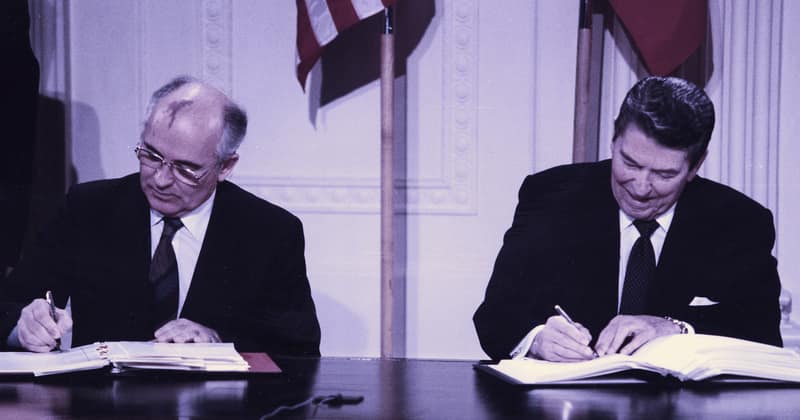
The most famous claimed timing is a signing. On December 8, 1987, Reagan and Gorbachev signed the Intermediate-Range Nuclear Forces Treaty in the East Room of the White House. The Reagan Library's record has the President speaking at 1:45 in the afternoon. Regan, in TIME's account of his book, said the Friend had determined that 2 p.m. on that day "was the most propitious moment" and that "the entire summit was built around that hour." The diplomatic historian Raymond Garthoff later wrote that the precise timing had been "a mystery" to the officials arranging it, and that only much later did it become known that the hour had been chosen by Nancy Reagan's astrologer.
Reagan himself was asked about it at the time. "No, it wasn't. Nothing of that kind was going on," he told reporters on May 17, 1988. "This was all, once again, smoke and mirrors." Asked if he believed in astrology: "I don't guide my life by it, but I won't answer the question the other way because I don't know enough about it to say is there something to it or not." Earlier that month he had put it more briskly: "No policy or decision in my mind has ever been influenced by astrology."
There is an older legend too. Reagan was sworn in as governor of California at ten minutes past midnight on January 2, 1967, and the stories credit astrology for the odd hour, though the stories cannot agree on which astrologer. Reagan said it was about stopping the outgoing governor from making last-minute appointments. As the legend goes, it was the stars. As Reagan told it, it was the judges.
The twist: she lost the client by being right about the secret
The revelations of 1988 ended it. Quigley met Ronald Reagan only once, she said, at a state dinner in 1985, and after Regan's book Nancy Reagan never spoke to her again. Quigley's description of being cut off is the best line in the whole saga: it was like "buying a Picasso and putting it in your living room and putting adhesive tape over the signature."
She died in San Francisco on October 21, 2014, aged 87. Her obituaries ran with two verdicts side by side. Carl Sagan's: "Some portion of the decision-making that influences the future of our civilization is plainly in the hands of charlatans." And Molly Ivins's, which is funnier and somehow kinder: "There the poor woman was, sitting in San Francisco with full accountability for world peace, and none of us even knew her name."
What did the stars actually do for the Reagans? Nobody can say, and that is the point. A good day picked for a treaty that was already negotiated proves nothing about the stars, which is why we test charts against placebos instead of anecdotes, and why our receipts say charts carry no return signal. What the calendar did do is easier to name. It gave a frightened woman a sense that someone was watching the dangerous days. Choosing a moment, which astrologers call electional astrology, is a ritual for exactly that feeling. If you want the green and red ink for your own big purchase, Electional days will colour the month ahead for you, and it will not pretend it gets you a better price.
Sources: Regan, For the Record (1988); Quigley, What Does Joan Say? (1990); New York Times obituary, October 2014; TIME, "Good Heavens!", May 16, 1988; People, "The President's Astrologers", May 23, 1988; AP via PBS NewsHour, 2014; Reagan's remarks, May 17, 1988; Reagan's remarks, May 9, 1988; Reagan Library: INF Treaty signing; Wikipedia: Joan Quigley.