The Astrologer Who Was Arrested for Fortune-Telling and Walked Out With a Ruling
In 1914 a New York police detective paid for a horoscope, and the astrologer who cast it ended up in court. She left with an acquittal, a written opinion from the magistrate, and the best advertising any astrologer in America has ever had.
A sting on the tenth floor
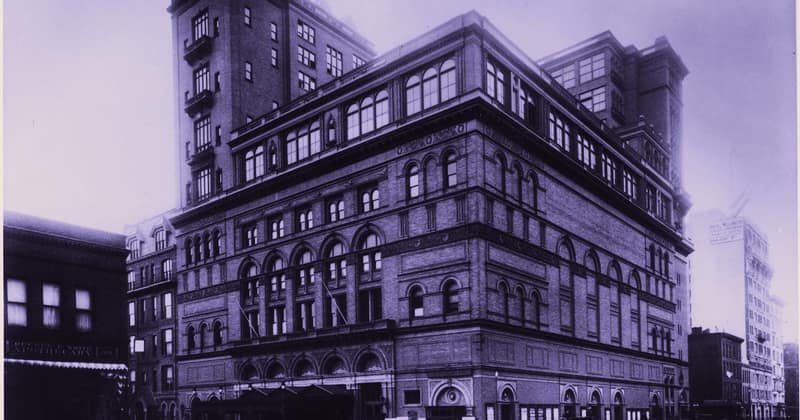
The studio was on the tenth floor of the Carnegie Studios, the apartments stacked above Carnegie Hall, and a reporter from the Evening World who visited that December described it as "curio-crammed." The woman who worked there was Evangeline Adams, a New Englander in her forties. She read horoscopes for a living, and by her own account she read them for some of the richest people in the city.
That was a problem in 1914, because fortune-telling was a crime in New York. So a woman detective came to the studio, paid, received a reading, and Adams was charged.
This was not her first time. When Magistrate Freschi ruled on her case in December 1914, the New-York Tribune reported that it was the third time she had been acquitted. (Some later accounts, Wikipedia's among them, date the case to May 1914; the newspaper reports of the ruling are from December, and the case may simply have run that long.) The police, an obituary would later put it politely, "on a few occasions interfered," and "she always won out in the courts."
The defence: this is not magic, it is mathematics
Adams did not argue that she was harmless. She argued that she was right. On the stand, as a Philadelphia columnist reported a few weeks later, she testified that astrology was "a mathematical and exact science." She was not claiming to see the future in a crystal. She was claiming to calculate the positions of the planets at a person's birth and read them by rules that had been written down for two thousand years. A fortune teller pretends. An astrologer, in her telling, computes.
Magistrate Freschi took the case under long advisement, which means he went away and thought about it, and then he wrote an opinion. It is the most remarkable document in the story, because it is real and it is on the record. "The science of astrology seems to be the generalization of certain principles gathered from the concrete phenomena presented by the heavenly bodies and their application to mundane affairs," he wrote. Of Adams herself: "She certainly does seem to have a thorough knowledge of the subject. And in this she claims no faculty of foretelling by supernatural or magical means that which is future or of discovering that which is hidden or obscure; but she does claim that nature is to be interpreted by the influences that surround it."
What was missing to convict her, he said, was fraud. And then the line the Tribune printed: "Every fortune teller is a violator of the law but not every astrologer is a fortune teller."
The legend grows in the retelling
That would be a good story on its own. It did not stay on its own.
The version you will find almost everywhere today, Wikipedia's included, has Adams, in open court, casting a chart from a birth date the judge handed her, which turned out to belong to his own son, and describing the young man so precisely that the judge was won over on the spot. The line usually quoted next is that she "raises astrology to the dignity of an exact science." Neither the son nor that sentence appears in the newspaper reports of December 1914 that we could find. The son reading comes down through later accounts, and the sentence is likely a later polish of what the judge actually wrote. So: as the legend goes, she read for the judge's son. As the record goes, she won on the law, and the judge went home and wrote a careful paragraph about mundane affairs. The legend is better theatre. The record is better evidence.
The fire, and the banker
Adams had a gift for stories that made her famous, and she told the two best ones herself.
The first is the Windsor Hotel. On March 17, 1899, a fire tore through the Windsor on Fifth Avenue and killed at least 45 people. Its owner, Warren Leland, lost his daughter. By her account, she was staying at the hotel. In her 1926 memoir, The Bowl of Heaven, she wrote that she had read Leland's chart the evening before and warned him he was "being pushed at that very moment into the very depths of disaster." She described him leaving her room: "He opened the door, and walked into the greatest hotel disaster of all time." No newspaper from 1899 we could find mentions the prediction. It enters print later, from her. It is a haunting scene, and it is her scene.
The second is J.P. Morgan. In that 1914 interview she listed her patrons as including "the late J. Pierpont Morgan," a copper speculator, a duchess, and a former president of the New York Stock Exchange. By the time of her death, the wire services were repeating that she had given Morgan "a sort of astrological bulletin service." Did the most powerful banker in America check the planets before he moved? As the legend goes, yes. The only witness is the astrologer. The famous quote pinned on him, that millionaires do not use astrology but billionaires do, has no source at all, and Morgan died in 1913, when nobody was a billionaire to compare himself with. We have written about what Morgan was probably paying for, and his own chart is on its own page, minus the bulletin service.
Radio, a famous assistant, and a tidy ending
Adams kept going for another eighteen years. In 1930 she had her own astrology programme on WABC, on the Columbia chain, broadcasting horoscopes to a country that had just watched the stock market fall apart. She published Astrology: Your Place in the Sun in 1927 and a companion book in 1930. For a while, one of her freelance helpers was the occultist Aleister Crowley, who later claimed a large share of the authorship of her astrology books, a fight that tells you a lot about both of them.
On the market itself, the record is thinner than the legend. A documentary about 1929 says she looked at the stars that February and predicted a strong rise in stock prices for the months ahead. Some later accounts say she foresaw the Crash. We found no record of that from before it happened.
She died in New York on November 10, 1932, of heart disease. Her husband told reporters she had been in a period of "adverse aspects," and the wire headlines did the rest: "Woman Seer Forecast Own Death." Even her obituary was a reading.
The twist
Here is what is strange about Evangeline Adams. The part of her life that sounds most like a tall tale, an astrologer winning a court case on the strength of her arithmetic, is the part that is documented. The parts that sound most like history, the banker, the fire, the son in the courtroom, are the parts that rest on her own word.
She understood something modern marketers spend fortunes learning. A ruling that says you are not a fraud is worth more than any ad. She got hers from a New York magistrate in 1914, and dined out on it for the rest of her life.
What the judge got right still holds. A chart is a calculation, and you can do it exactly. What a chart means is a reading, and readings are human. Ours computes the sky the same rigorous way she did, and then we tested whether charts say anything about returns and published a firm no. If you want to see what she would have computed for you, the reading does it in about a minute, no detective required.
Sources: New-York Tribune, December 12, 1914; Evening World, December 14, 1914; Evening Public Ledger, December 30, 1914; Evening Star, November 11, 1932; Washington Times, November 11, 1932; Evening Star radio listings, July 9, 1930; Wikipedia: Windsor Hotel fire; Wikipedia: Evangeline Adams; Wikipedia: Aleister Crowley; PBS American Experience: The Crash of 1929.