Chai Is 18. Adam Is 45. Your Name Is Next.
In Hebrew gematria every letter carries a number, so every name carries a total, and people have been reading meaning into those totals for about two thousand years, Kabbalists since the Middle Ages. Your name has been sitting on a number this whole time. Here is what happens when it meets the Tree of Life.
The oldest spreadsheet trick in the world
Gematria gives each Hebrew letter a value: aleph is 1, bet is 2, up through tav at 400. Add a word's letters and you get its total. The famous one is chai, the word for life, which sums to 18, which is why gifts in Jewish tradition come in multiples of 18. A lucky number with receipts going back to antiquity. Your name probably was not written in Hebrew, so it gets transliterated first by documented rules (sound-pairs like sh and ch become one letter, doubled letters collapse, short middle vowels drop out the way Hebrew leaves them unwritten), then summed.
Watch it happen to Adam
Adam is three Hebrew letters: aleph (1), dalet (4), mem (40). Total 45. Kabbalah reduces that by mispar katan mispari, which is just adding the digits: 4+5 = 9. No master numbers, on purpose, that is numerology's move and gematria plays by its own rules. The 9 picks a sphere on the Tree of Life, the map of ten emanations called sephirot. Nine lands on Yesod, the sphere of the Moon, and the Moon means consumer staples: groceries, household brands, the steady stuff. The literal first man reduces to the aisle that sells bread and soap.
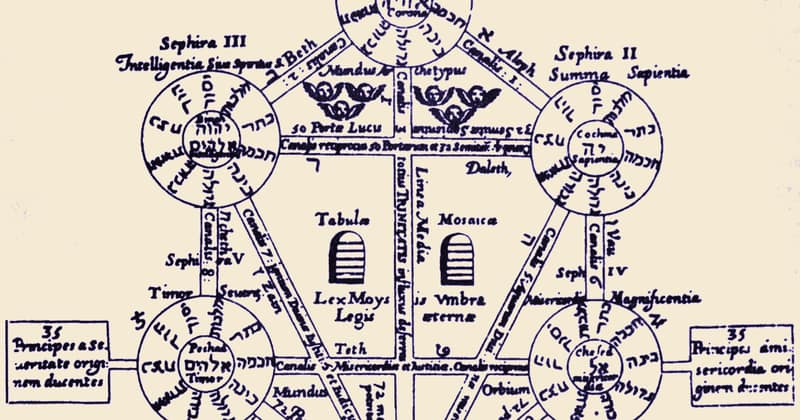
The Tree of Life as a sector map
The Golden Dawn tradition (Regardie's The Golden Dawn, Crowley's Liber 777) pinned a classical planet to seven of the spheres, and each planet drags its sector along:
- Binah (3), Saturn. The strict grandmother. Utilities.
- Chesed (4), Jupiter. Generosity at scale. Big banks.
- Gevurah (5), Mars. The enforcer. Industrials.
- Tiferet (6), the Sun. Main-character energy. Gold.
- Netzach (7), Venus. The aesthete. Consumer discretionary.
- Hod (8), Mercury. Fast talk, fast signals. Tech and software.
- Yesod (9), the Moon. The homebody. Consumer staples.
The other three get no classical planet, so the app extends them and admits it: Keter (1) becomes the 60/40 portfolio, Chokmah (2) becomes quantum and frontier tech, Malkuth (10) becomes REITs and precious metals. All three are labeled post-classical extensions right in the code, because nobody gets to invent tradition without a label.
Then your birthday tilts it
Classical planetary hours hand each weekday a ruler, Sunday to the Sun through Saturday to Saturn. The app blends your name's sephirah (70 percent) with your birth day's ruler (30 percent). A Moon-name born on a Saturn-day comes out mostly staples with a side of utilities. Cozy, structured, probably owns a label maker.
None of this predicts anything
That is the honest part. It is an old, fully traceable way to watch your own name look back at you from a portfolio, which is a strange and delightful thing to own. Hand NatalWealth your name and it runs the whole ritual in front of you: letter values, reduction trail, sephirah, sector math, all of it.
Sources: letter values, the reductions and gematria's ancient roots from Wikipedia's entry on gematria; the medieval rise of Kabbalah from its entry on Kabbalah; the Golden Dawn planet-to-sephirah map from Hermetic Qabalah.